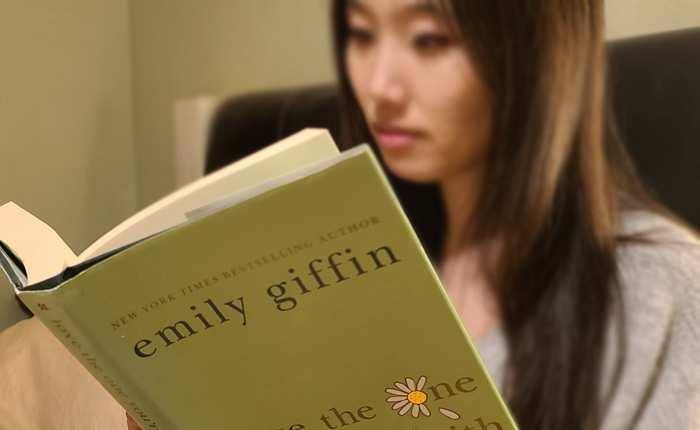
Emily Giffin and College Elitism
The term “chick lit” is often used derisively to refer to a genre of literature thought to appeal to young women; indeed, the Oxford dictionary goes so far as to classify it as a derogatory turn of phrase. Typically, the chick lit genre revolves around romantic relationships, such that I like to think of it as the literary equivalent of the romantic comedy. Now, all kinds of people have all kinds of opinions concerning the idea of chick lit, whether it is substantive, or frivolous, or trite. Personally, I would liken it to fast food — not likely to be complex or fulfilling in the way of a gourmet sit-down meal, but still tasty and enjoyable in its own right. That said, I do very much enjoy reading chick lit; but it must be said that books falling under the chick lit umbrella are undeniably lighter and less complicated than, say, the heavy literary masterpieces that are John Knowles’s A Separate Peace or David Guterson’s Snow Falling on Cedars (two of my personal favorites!). And I don’t necessarily intend that as a criticism, because it is perfectly fine: I often read chick lit in large part because I want something lighter and less complex, or because I want something fun rather than meaningful.
On that note, Emily Giffin is one of the most prolific and well-known chick lit writers in the industry. Her debut book, Something Borrowed, was adapted into a movie, and several of her other works have been similarly optioned. I have a number of views on Emily Giffin as an author — suffice it to say that, as of late, I have found her writing to be performative, unbelievable, and holier-than-thou — but perhaps these particular thoughts are best left for another day. The fact remains, though, that I have read all of her books and found each to be entertaining; and with the exception of her most recent works, her novels are disarmingly and surprisingly relatable, rife with moments of unexpected depth.
What’s in a Name?
Still, one particular issue I take with Giffin’s writing is her seeming obsession with sending her protagonists to elite universities — Rachel White attended Duke as an undergraduate and then law school at NYU, while her friend Ethan is a Stanford alumnus[1]Giffin, Emily. Something Borrowed.; Claudia Parr is a Princeton graduate[2]Giffin, Emily. Baby Proof., while Tessa Russo attended Cornell; Valerie Anderson is a graduate of Harvard Law School opposite Nick Russo, who attended Harvard Medical School[3]Giffin, Emily. Heart of the Matter.; and Nina Browning went to Vanderbilt[4]Giffin, Emily. All We Ever Wanted., to name just a few examples.
I am hard-pressed to believe that the foregoing spread of university attendance is representative of the population at large — for example, Stanford and Princeton, as undergraduate institutions, boast acceptance rates of only 5.2% and 5.6% respectively as of 2020 — and so it seems clear enough to me that Giffin does not choose the schools that she does in order to make her characters relatable. I looked into Giffin’s college attendance to see if her obsession with elite schools perhaps stems from her own personal experience; Giffin is a graduate of Wake Forest University, and also of the University of Virginia School of Law, both of which are fantastic schools — but she certainly isn’t sending her characters to either of them in droves, the way she likes to cart them off to, say, the Ivy League.
Perhaps Giffin’s fixation on sending her characters to only the best universities would not be so unsettling, if she left it at that; but in Baby Proof, Giffin seems to go out of her way to portray protagonist Claudia Parr’s sister, Daphne — an alumnus of Hofstra University, a perfectly good school, though perhaps not the very first that comes to mind with respect to elite, exclusionary universities — as “simple”[5]Giffin, Emily. Baby Proof. and dull. At one point in the book, Claudia visits Daphne at her home; there, Daphne describes a book that she is reading for her book club as “thought-provoking”, [6]Giffin, Emily. Baby Proof. prompting the following response from Claudia:
“I glance at Daphne, thinking that it is quite possibly the first time Daphne has referred to her thoughts as being provoked. My sister is not at all dumb, but she is far from introspective.”[7]Giffin, Emily. Baby Proof.
On another occasion, Jess — Claudia’s best friend, and a fellow Princeton graduate, plus an alumnus of Columbia Business School — flaunts her affair with a married man in front of Maura — another of Claudia’s sisters, who at the time is struggling with her own husband’s unrepentant infidelity. Naturally, Maura takes Jess’s behavior personally and rebukes her in what is a rather poignant piece of dialogue…until Daphne misses the point, so flagrantly that it is almost comical (which I suspect Giffin intended it to be):
“ ‘I’ll remind you of that someday,’ Maura says, her voice shaking a little. ‘…I’ll remind you of that after you’ve just had his baby and you have postpartum depression and feel fat as a cow and you are pumping milk into little plastic containers in the middle of the night while he’s running around with some twenty-two-year-old named Lisette. I’ll remind you of that.’
‘Wait a second,’ Daphne says. ‘You didn’t breast-feed.’ ”[8]Giffin, Emily. Baby Proof.
Throughout the rest of Baby Proof, Daphne continues to serve as the intellectual butt of Giffin’s jokes, for want of a better word: at one point, she is the only person at a table of Ivy League alumni who does not know the meaning of the term “eugenics”; at still another, Jess laughingly describes Daphne as “boring”[9]Giffin, Emily. Baby Proof. — as if you need to attend an elite university to be interesting or intelligent.
…And Why?
I am at a loss as to why Giffin feels the need to have her characters attend such prestigious universities. I might understand, if not sympathize, if she had attended such universities herself and was a zealously proud alumnus; but this seems not to be the case. I don’t mean this as a slight to the schools she attended, or to any school perhaps not at the immediate forefront of the ranks of what might be considered the country’s hyper-elite academic institutions — indeed, I am a big proponent of the public school system, as well as of the idea that the university that we attend has very little (if anything) to do with our intelligence or capability. To that end, then, I am at an even greater loss as to why Giffin feels the need to portray characters that have not attended prestigious schools as being one-dimensional or simple.
Now, it may be worth noting that in her more recent works, Giffin has apparently become more amenable to sending her protagonists to slightly less exclusionary schools: Love the One You’re With’s Ellen Graham is a graduate of Wake Forest University like Giffin herself[10]Giffin, Emily. Love the One You’re With., while Cecily Gardner of The Lies that Bind is an alumnus of the University of Wisconsin[11]Giffin, Emily. The Lies that Bind. — and both characters are winsomely portrayed as well-rounded and bright, ambitious and multi-faceted. I stress the latter point because, for me personally, the problem was never Giffin’s preoccupation with elite universities; but rather, the unflattering juxtaposition she would create between the alumni of such schools and the alumni of less conventionally prestigious institutions. Perhaps, then, Giffin has revised her views about what a person’s alma matter says about their character and intelligence. One can only hope.
Still, I can’t help but continue to wonder why, exactly, Giffin was at one point so fixated on Ivy-League-tier schools. And on some level, she still is, lending credence to the adage that old habits die hard: while Giffin has seemingly become more open to her protagonists’ attending less exclusive schools, many of the characters in her most recent releases continue to be Stanford and Harvard alumni.[12]Giffin, Emily. The Lies that Bind.[13]Giffin, Emily. Meant to Be. Maybe she wants to live vicariously through her characters, something I certainly don’t fault her for — who wouldn’t want to attend a school of the likes of Princeton or Yale? Or maybe she has some other perfectly innocuous motivation, like wanting to pick schools that she is convinced her readers will have heard of. And of course, there is always the sobering possibility that she really is just something of an elitist with respect to higher learning. Likelier than not, though, there’s no real reason; but I think it remains an issue worth flagging.
The content of this post constitutes an expression purely of my personal opinion. The various facts and quotations referenced in support of it have been cited to their proper sources. If you see any errors in any of the factual references made, please let me know.
References
| ↑1 | Giffin, Emily. Something Borrowed. |
|---|---|
| ↑2, ↑5, ↑6, ↑7, ↑8, ↑9 | Giffin, Emily. Baby Proof. |
| ↑3 | Giffin, Emily. Heart of the Matter. |
| ↑4 | Giffin, Emily. All We Ever Wanted. |
| ↑10 | Giffin, Emily. Love the One You’re With. |
| ↑11, ↑12 | Giffin, Emily. The Lies that Bind. |
| ↑13 | Giffin, Emily. Meant to Be. |


Ash
January 25, 2023 at 8:12 pmI feel for Daphne…😭
It is kind of upsetting! I feel that the author is somewhat promoting the misconception that the prestige of a college has a direct correlation to intelligence and overall future success in life…