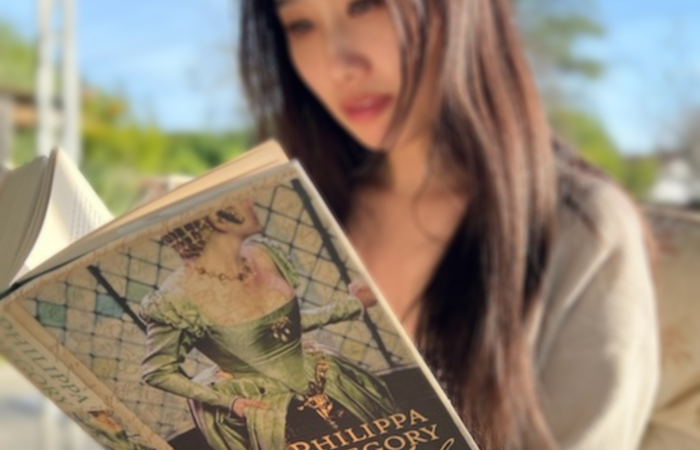
A Critique of Philippa Gregory
No author raises my hackles quite like Philippa Gregory does. Put as succinctly as possible, Gregory — who markets herself as a historical fiction writer specializing in the Tudor-era — takes pride in creating supposedly richer, more nuanced portraits of the characters she portrays, most of whom are historical women of relative factual obscurity. Indeed, Gregory has regularly suggested that she gives voice and depth to historical women whose lives “have been ignored by historians, and…viewed [only] as pawns in the dynastic battles of Europe,”[1]Gregory, Philippa. Three Sisters, Three Queens. or who have otherwise been “neglected and traduced by conventional history.”[2]Kellaway, Kate. “Philippa Gregory: unearthing history’s forgotten women.” The Guardian.[3]Gregory, Philippa. The Boleyn Inheritance.
I find the reality, however, to be somewhat different. In writing her characters, Gregory not only tends to create one-dimensional, grossly polarized caricatures of the women off whom they are based, but also acts more as a revisionist than the historian she claims to be — by frequently pushing a reimagined version of Tudor history shaped by her personal biases and preferences, one that aligns more with what she wishes would have actually happened. Given Gregory’s enormous platform as a bestselling author, I find this practice to be, quite frankly, just a tad irresponsible.
Not Quite A Historian
In my opinion, most if not all of the issues that make Gregory such a problematic writer, derive from her insistence on marketing herself as a historian; when in actuality, Gregory cherry-picks only the bits of history that fit an often highly fictionalized narrative of her own personal invention, and then twists any facts that conflict with said narrative to make them consistent with the story she chooses to tell. Given Gregory’s mainstream popularity — I would go so far as to say that she is probably the most popular, or at least probably the most well-known, author of Tudor-era fiction — her tendency to propagate these often grossly untrue takes is beyond frustrating to me. (To wit, Gregory’s About the Author blurb is also brazenly misleading. She describes herself as having “studied history at the University of Sussex and received a Ph. D. from the University of Edinburgh,” but conveniently refrains from mentioning that said Ph. D. is in literature rather than history, as the blurb seems meant to imply.)
Nonetheless, Gregory has been called the “queen of royal fiction” by USA Today, which I find to be a bit of an ironic travesty. She got her big break, so to speak, with the release of her novel The Other Boleyn Girl in 2001, and since then has become one of the more popular authors dabbling in historical fiction; several of what she calls her The Plantagenet and Tudor novels have been best-sellers that have reached a widespread global audience. So it is especially unfortunate that many of these novels are riddled with historical inaccuracies — in the form of both outright falsehoods and subtler misrepresentations, most of which are willfully, purposefully made in order to suit her preferred narrative.
Through her Plantagenet and Tudor novels, Gregory has written from the point of view of Margaret Beaufort, Mary Boleyn, and Anne of Cleves, to name just a few. Indeed, Gregory prides herself in what she calls, essentially, giving a voice to the women who have been otherwise largely neglected by history, or at least by historical record. But it is precisely because there is such sparse information available with respect to these women, that any fictionalized account of their personalities must be almost entirely the product of speculation. It is difficult enough to create a nuanced portrait of a person whose life has been extensively documented, much less one of a person about whom we know next to nothing. Accordingly, Gregory ends up writing a one-dimensional character that she then claims is a historically accurate representation of the figure off of which she is based.
“Rounded” Personalities
Gregory’s one-note portrayals might not be too egregious, given that so little information is available regarding the figures about whom she writes; rather, the issue is that Gregory openly claims to create complex, layered portraits of the women she depicts in her works. Gregory seemingly takes great pride in what she believes to be her portraying these women “as individuals” and offering insight into “their inner lives,” so as to allow readers “imagine them as rounded personalities.”[4]Gregory, Philippa. Three Sisters, Three Queens. In her 2008 novel, The Other Queen, Gregory writes from the point-of-view of Mary, Queen of Scots:
“ ‘People always make up stories about princesses…For most of my life I have been adored by fools and hated by people of good sense, and they all make up stories about me in which I am either a saint or a whore.’ ”[5]Gregory, Philippa. The Other Queen.
The underlying subtext here, I believe, necessarily implies that such gross simplification is wrong; and that Gregory herself neither (1) condones it; nor (2) engages in it. Indeed, with respect to her 2006 novel, The Boleyn Inheritance, Gregory also writes that:
“Anne of Cleves and Katherine Howard are the two wives of Henry VIII we know least; as is so often the case, we think we know them well. In this fictional account of the real facts I have tried to get past the convention that one wife was ugly and the other stupid, to consider the lives and circumstances of these two very young women who were, so briefly, the most important women of England, successive wives to a man on the brink of madness.”[6]Gregory, Philippa. The Boleyn Inheritance.
Gregory further claims that The Boleyn Inheritance “rescues the reputation of two queens who have been neglected and traduced by conventional history — historians still call Anne of Cleves ‘fat’ and Katherine Howard ‘stupid’ ” and that, accordingly, in writing the book, it “matter[ed] to [her] that they [would be] considered carefully as real people.”[7]Gregory, Philippa. The Boleyn Inheritance. Further to that point, Gregory has criticized what she calls “the stereotyped view of women by later historians” holding, in essence, that “a ‘good’ woman…must have been incapable of telling a lie,” before rather sanctimoniously adding that she “tend[s] to take a more liberal view of female mendacity” in her own writing.[8]Gregory, Philippa. The King’s Curse.
Having actually read many of Gregory’s Plantagenet and Tudor novels, I find that Gregory’s claims of depth and modernism fall rather flat. To the contrary, as far as I can tell, Gregory writes her characters to be so one-dimensional, so polarizing, that it is difficult to see them as anything other than caricatures of the women they are meant to represent. Not only that, but many of her character portrayals actually perpetuate the dated stereotypes about the figures off of whom they are based, the very stereotypes that Gregory supposedly resents. To that end, my read-throughs of Gregory’s novels have generally failed to find the complex, progressively modernized portraits she claims to create: in her writings, Gregory has regularly doubled down on the stereotypes that Margaret Beaufort was frigid and overbearing; that Katherine Howard was dull and airheaded; and that Anne Boleyn was singularly cruel and self-serving, to name just a few. Indeed, I personally find that Gregory’s depictions of Anne Boleyn, Katherine Howard, and Catherine of Aragon are the most egregious instances of her one-dimensional characterizations.
Anne Boleyn
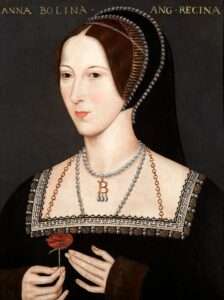
Anne Boleyn, by Unknown
If you have read any of Gregory’s Tudor novels, I imagine that it should be glaringly obvious precisely where her sympathies lie; but on the off chance that it isn’t, I can fill you in — Gregory’s adoration of Catherine of Aragon, first wife of Henry VIII, is rivaled only by her hatred of Anne Boleyn, second wife of Henry VIII, who claimed the throne by capturing the attentions of the king and effectively pushing her predecessor aside. (Her dislike of Anne Boleyn is such that it percolates down to her daughter, Elizabeth I, whom she has described as having a “typical, narcissistic lilt” about her, such that she was “always ready to fall in love with herself”[9]Gregory, Philippa. The Virgin’s Lover.; her love for Catherine of Aragon similarly percolates down to her daughter, Mary I, whom she has described as “a most beautiful woman” that “[n]obody could help loving.”)[10]Gregory, Philippa. The Queen’s Fool. Indeed, in The Other Boleyn Girl, Gregory rather shamelessly demonizes Anne Boleyn, all while simultaneously beatifying Catherine of Aragon.
In The Other Boleyn Girl, Anne is depicted as a cold, calculating, haughty young woman, completely unfazed by the prospect of committing murder or incest to secure her position as queen of England (a lofty accusation for Gregory to make, in my opinion, given that history fails to definitively establish that Anne engaged in either). I will admit that her portrayal could be sympathetic, at times — Gregory allows Anne to display a rare trace of humanity when she is heartbroken at her separation from Henry Percy, 6th Earl of Northumberland — but on the whole, she is largely unlikable, prone to hysterical fits of violence and vanity: Gregory has Anne physically beat her sister Mary Boleyn on multiple occasions, maliciously separate her from her children, and poison a Bishop, to name just a few things.
Gregory’s singular determination to depict Anne Boleyn as a villain is such that she re-imagines and characterizes even the latter’s good deeds as acts of spite: historically, Anne Boleyn took Henry Carey — the son of her then-destitute sister, Mary — as her ward and acted as his patron and advocate, as his own mother had no means of providing for him.[11]Starkey, David. Six Wives: The Queens of Henry VIII. It was, in fact, only through her influence that Carey ultimately received a superb education at a Cistercian monastery, as it was only through her intercession that the widowed Mary Boleyn received a pension of £100. However, The Other Boleyn Girl instead suggests that Anne forcibly removed Henry Carey from Mary’s care and adopted him as her own child not out of any particular generosity, but in order to have a son of her own with whom she could further entice Henry VIII to marry her. It similarly suggests that Anne was more than content to leave her widowed sister to languish in poverty — when in actuality, it was Anne who regularly acted as Mary’s primary benefactor at court, pushing for her and hers to receive the monies and positions to which she felt they were entitled.[12]Weir, Alison. The Six Wives of Henry VIII.[13]Starkey, David. Six Wives: The Queens of Henry VIII.
Catherine of Aragon
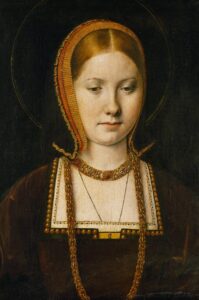
Catherine of Aragon, by Sittow
Conversely, Gregory so loves Catherine of Aragon that she not only portrays Catherine as beautiful, indomitable, and majestic, but also goes so far as to negatively characterize anyone whose interests ran counter to Catherine’s. It is, for example, debatable that any historical figure treated Catherine worse than her husband of twenty years, Henry VIII; and suffice it to say, Gregory’s distaste for Henry VIII is on ready display in all and any of her books. Writing in the voice of Jane Boleyn in The Boleyn Inheritance, she paints a less-than-flattering image of Henry VIII on more than a few occasions, once when he is helping himself to dinner:
“He is cramming food into his mouth as we watch him, both hands up to his face; he is fatter than any many I have ever seen in my life before, his shoulders gross, his neck like an ox, his features dissolving into the moon-shaped vat of his face, fingers like swollen puddings.”[14]Gregory, Philippa. The Boleyn Inheritance.
And then again, when he has just been rebuffed by Anne of Cleves, describing him as:
“…[A]n old man, long past his prime, no longer handsome, no longer desirable, a man that a young woman would push roughly away from her because she could not stand his smell, because she could not bear his touch…[H]e is a foolish old man who thought he could put on a cape and a hood and ride out to meet a girl of twenty-four, and she would admire the handsome stranger, and fall in love with the king. He is shocked to his soul, and now he looks foolish and confused like a muddled grandfather.”[15]Gregory, Philippa. The Boleyn Inheritance.
In the same book, she even goes so far as to make the (as far as I could find — please do correct me if I’m mistaken) baseless claim that the abrasive Duke of Norfolk ever “really loved only one woman and that was Katherine of Aragon,” seemingly for the sole purpose of further cultivating Catherine’s image as saintly, perfect, universally adored.[16]Gregory, Philippa. The Boleyn Inheritance.
Gregory’s 2005 novel, The Constant Princess, which focuses on Catherine of Aragon, further celebrates her determination, poise, and grace under fire, while also managing to disparage her father-in-law, Henry VII. Admittedly, Henry VII did treat Catherine notoriously poorly while she was a widow in England, following the death of her first husband, Arthur; but The Constant Princess presents him as something of a bumbling fool, secretly carrying a flame for Catherine and desperately besotted with her — when in actuality, Henry VII was apparently quite smitten with Catherine’s sister, Juana, and sought to marry her after the passing of his wife, Elizabeth of York.[17]Starkey, David. Six Wives: The Queens of Henry VIII. To that end, Henry VII’s marriage to Elizabeth of York is one of the few that the histories suggest was actually happy and successful[18]Penn, Thomas. Winter king: Henry VII and the dawn of Tudor England.[19]Weir, Alison. The Six Wives of Henry VIII.; yet Gregory regularly implies that it was a tense, frigid affair[20]Gregory, Philippa. The White Princess., if only because she can’t bear to either (1) suggest that Henry VII could ever be a pleasing husband; or (2) grant Henry VII marital happiness, even that of a fictional variety — given how poorly he treated Gregory’s beloved Catherine of Aragon.
Katherine Howard
Gregory has claimed that in writing The Boleyn Inheritance, she “tried to get past the convention that [Katherine Howard was] stupid” so as to “rescu[e]” her reputation, so “traduced by conventional history.”[21]Gregory, Philippa. The Boleyn Inheritance. On my reading of The Boleyn Inheritance, however, I personally found the opposite to be true: indeed, Gregory seemingly fully embraced Katherine’s reputation as a dull, empty-headed young woman of little learning or discretion in writing the character.
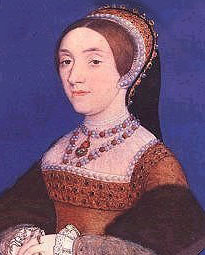
Possible likeness of Katherine Howard, by Holbein
Throughout the novel, Gregory describes Katherine Howard dismissively, on one occasion referring to her as “a girl whom [the king] could bed for little more than the price of a gown,” and on another as “the most common commoner ever to sit on a better woman’s throne.” She later doubles down on Katherine’s apparent vapidity through the opinions expressed by other characters in the book: at one point, Katherine Howard’s own uncle fumes, “God help us, the girl is an idiot;” while Jane Boleyn comments that she “can almost hear the slow revolving of [Katherine’s] thoughts.”[22]Gregory, Philippa. The Boleyn Inheritance.
You would be forgiven for thinking that Gregory was, perhaps, trying to give Katherine depth by suggesting that it was her contemporaries who wrongly dismissed or viewed her as stupid and that, in reality, she was actually a sharp, astute young woman. However, this is clearly not the case either, as Gregory also writes from the point of view of Katherine Howard herself, and regularly paints her as being confused and bored by the world around her, except where there are ribbons and dresses involved. Indeed, in the voice of Katherine Howard, Gregory writes:
“I turn my head one way to appear as if I am listening…[but] I don’t hear any of them, to tell truth. It is all buzz, buzz above me, and there are no musicians and no dancing and nothing to amuse me but the conversation of my husband, and what bride ever wanted that?”[23]Gregory, Philippa. The Boleyn Inheritance.
And that is really it — at no point in the book, even nearing its end, does Katherine display any more substance than this, despite Gregory’s rather self-aggrandizing assertions that she actively strove to portray Katherine as more than just the dull, vapid youth that history has supposedly claimed her to be.
The Takeaway
It is, in my opinion, readily apparent that Gregory likes to think of herself as a champion of the forgotten woman, in no small part because of what she believes to be her role in creating supposedly nuanced portraits of women otherwise neglected by historical record.[24]Kellaway, Kate. “Philippa Gregory: unearthing history’s forgotten women.” The Guardian. Yet she strikes me more as precisely the type of person she criticizes in The Other Queen; that is, the type that “make[s] up stories about [princesses] in which [they are] either a saint or a whore.”[25]Gregory, Philippa. The Other Queen. There is rarely any in-between in Gregory’s writing; her characters tend to be either winsome and charming, or obnoxious and insufferable — and the portrayal they receive is almost entirely dependent on her personal feelings toward them.
I am aware that as humans we are all given to our own preferences and biases, whether known or unknown. Indeed, I probably would not take such issue with Gregory’s writing were it not for the fact that my own biases happen to run exactly opposite hers: I have great admiration for the tenacity and intelligence of Anne Boleyn, as well as for the willpower of Margaret Beaufort — another historical figure Gregory clearly dislikes, likely because she was not exactly a benefactor of Catherine of Aragon (but I would point out that neither preference prevents me from also feeling a great deal of sympathy for Catherine of Aragon; and were I ever to, say, dabble in writing historical fiction, from portraying her fairly, something that seems lost on Gregory). To Gregory’s credit, she has acknowledged that some parts of her novels “are history, some are speculation, and some are fiction,”[26]Gregory, Philippa. The Red Queen. and also that the “feelings [of the characters she writes]…can only be a matter of speculation in the absence of any personal record.”[27]Gregory, Philippa. Three Sisters, Three Queens. Still, when you are a famous author with a large platform capable of reaching millions of readers, and you insist on marketing yourself as a relatively objective historian, whose novels are largely historically accurate except for the “feelings and motivations”[28]Gregory, Philippa. The Other Boleyn Girl. of the characters involved, then I think a little more accountability might be in order.
If I could stress only one point to anyone about to read Gregory’s Plantagenet or Tudor-era novels, it would be that Gregory is at least as much a revisionist as she is a historian. Now, I might also be tempted to stress that neither she nor anyone else, really, can help that — I would posit that all historians must be in some part revisionists, as it is impossible to know the exact course of even the most fastidiously documented events of yore, much less how the people involved felt and thought as individuals. I do fully understand that writing historical fiction necessitates the taking of creative liberties. But Gregory’s problem, in my opinion, is that she projects her personal biases into her writing often to the pronounced disservice of other historical figures, i.e., those toward whom she feels personal antipathy, such as Anne Boleyn — all while marketing herself as both a relatively objective historian as well as an advocate of the women marginalized by history. To that end, it would probably be more accurate for her to refer to herself as an advocate for only the women that strike her personal fancy. For her to claim anything else, I think, would be a gross, even irresponsible, misrepresentation.
The content of this post constitutes an expression purely of my personal opinion. The various facts and quotations referenced in support of it have been cited to their proper sources. If you see any errors in any of the factual references made, please let me know.
References
| ↑1, ↑4, ↑27 | Gregory, Philippa. Three Sisters, Three Queens. |
|---|---|
| ↑2, ↑24 | Kellaway, Kate. “Philippa Gregory: unearthing history’s forgotten women.” The Guardian. |
| ↑3, ↑6, ↑7, ↑14, ↑15, ↑16, ↑21, ↑22, ↑23 | Gregory, Philippa. The Boleyn Inheritance. |
| ↑5, ↑25 | Gregory, Philippa. The Other Queen. |
| ↑8 | Gregory, Philippa. The King’s Curse. |
| ↑9 | Gregory, Philippa. The Virgin’s Lover. |
| ↑10 | Gregory, Philippa. The Queen’s Fool. |
| ↑11, ↑13, ↑17 | Starkey, David. Six Wives: The Queens of Henry VIII. |
| ↑12, ↑19 | Weir, Alison. The Six Wives of Henry VIII. |
| ↑18 | Penn, Thomas. Winter king: Henry VII and the dawn of Tudor England. |
| ↑20 | Gregory, Philippa. The White Princess. |
| ↑26 | Gregory, Philippa. The Red Queen. |
| ↑28 | Gregory, Philippa. The Other Boleyn Girl. |
Leave a Reply